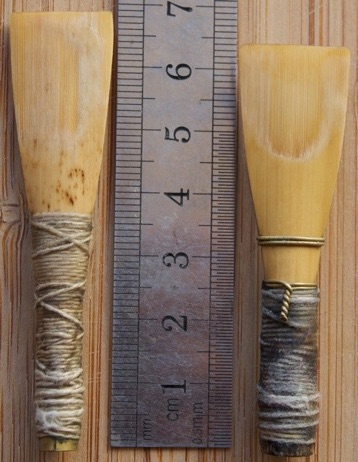
The reed on the left is a reconstruction of a 17th century reed. The blades are bound on a brass staple, like the reed of an oboe or Irish bagpipe. There are no wires. You can hear me playing this reed on my curtal in a live performance of GA Bertoli’s sonata prima (1645) in the sound file above right.
The reed on the right is based on late 18th/early 19th century originals. You can hear me playing this reed on my baroque bassoon in a studio recording of M Corrette’s sonata V in the sound file at top right.
There are several important differences between historical and modern bassoon reeds. In historical reeds the profiling is carried out on the inside of the cane, not the outside. Historical scrapes taper from back to front but are more or less even across their profile; there is no ‘spine’ as in modern reeds. The sound and response of historical reeds is very different to the modern-style ‘baroque’ reeds used by the overwhelming majority of players today. Many historical bassoon players consider historical reeds intolerably buzzy. Yet this style of reed was universally used until at least the late 19th century (much later in some places) so there is a good historical precedent for making such a sound. I find it wonderfully rich and reedy!